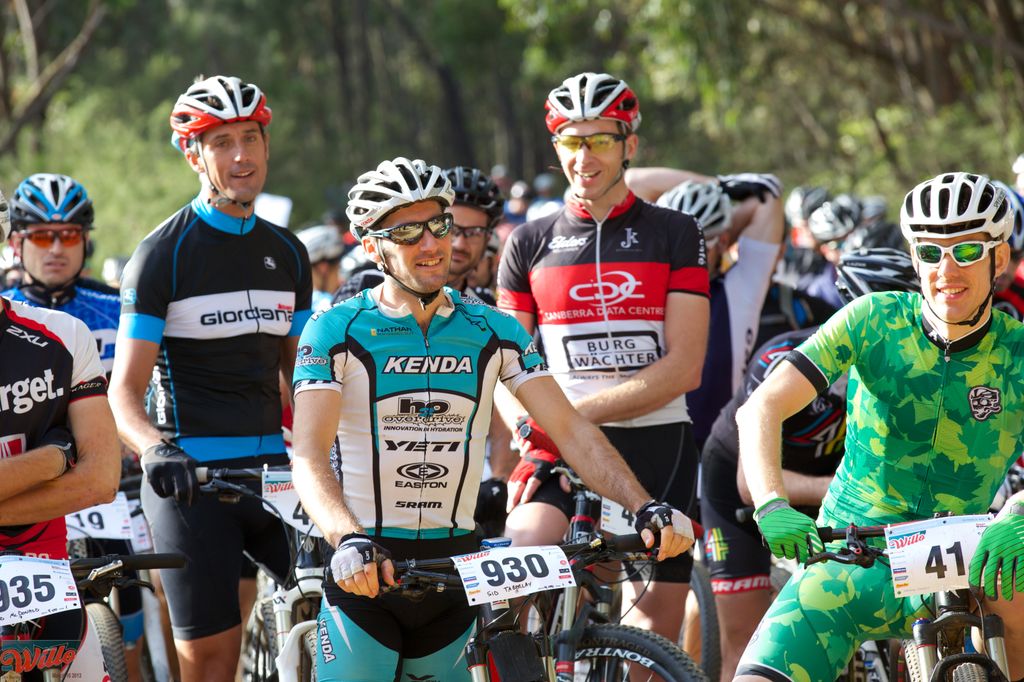
The relaxed, friendly vibe on the start line speaks volumes about this event.
I’ve already written a story on the Willo Enduro for Flow Mountain Bike, so I won’t repeat similar thoughts again here. What I didn’t write about in that article, though, was the way my own experience of the race was made even more special due to riding an unfamiliar bike.Continue reading “Wild Wheels and the Willo Enduro”
The Australian Mountain Bike Championships is a multi-day event which brings together a huge collection of talented, passionate people. In addition to our country’s elite and up-and-coming racers rolling around the car-park-come-event-centre, tons of bike industry folk and local media personalities are an important part of the weekend as well.
I spent the 2013 Champs working as part of a three-person crew with Flow Mountain Bike’s Chris Southwood and Mick Ross. Armed with my camera and a voice recorder I enjoyed the change in rhythm from typing stories and the different challenges quick, timely and unique web content allow.Continue reading “Media-ing the Subaru Australian MTB Champs”
The Year of Shred got off to an interesting start at the CamelBak-WSMTB 4 Hour race last weekend at Yellowmundee. Instead of tearing up the trails, the trails tore up me.
But I wasn’t the only one. Hot weather had made for a slippery, sandy surface which caught many people out on the familiar club track. While a lot of riders crashed their bikes through transition in the opening laps, I’m pretty sure I was the only one to do it twice.
The event had a professionally run, yet low-key and social feel.
I’d made things a bit harder for myself with some compromised equipment choices, you see. First up, I’d over-inflated a leaky front tyre so it stayed up for an opening double lap. Not the smartest thing to do in preparation for loose sand. Next, I’d been too busy to service my forks when they needed it, meaning the rebound and most of the travel were on hiatus that weekend.
Changing the front tyre and grips had also lightened up the front end of my bike, which I’d failed to recognise until it started to handle differently on climbs. A raised front end, a leftover mod I’d forgotten about after riding a downhill trail, changed the handling further still.
Add to this the early morning feeling where you want to go back to bed for two more hours and the only thing racey about this rider/bike combo was the number stuck on the front. After stylishly losing skin on both legs and tearing up some new knicks, I took it fairly easy for the remainder of the first two laps and made a check list of things to alter before heading out for another.
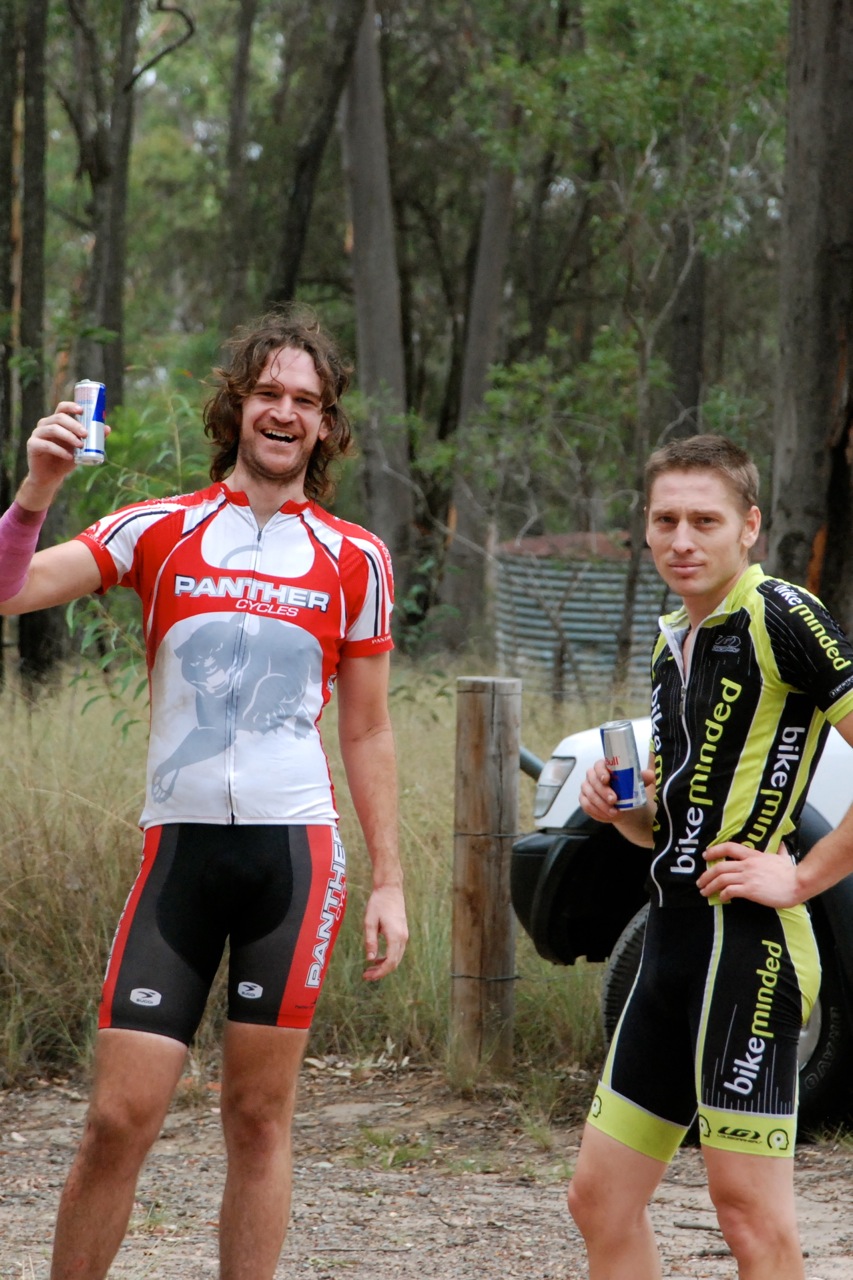
Red Bull for the win!
The total lack of regard for careful bike prep hopefully signifies that I wasn’t really at the race to ride my best. The WSMTB 4 Hour series was just too good a chance to throw my bike in the car and catch up with a whole lot of mates. Mates like Brian ‘Big Dog’ Price who gave me a desparately craved Red Bull to switch my brain on for the rest of the day. And Rosie Barnes who’d come up to visit from Canberra for the weekend and let me talk her into racing the women’s pairs.
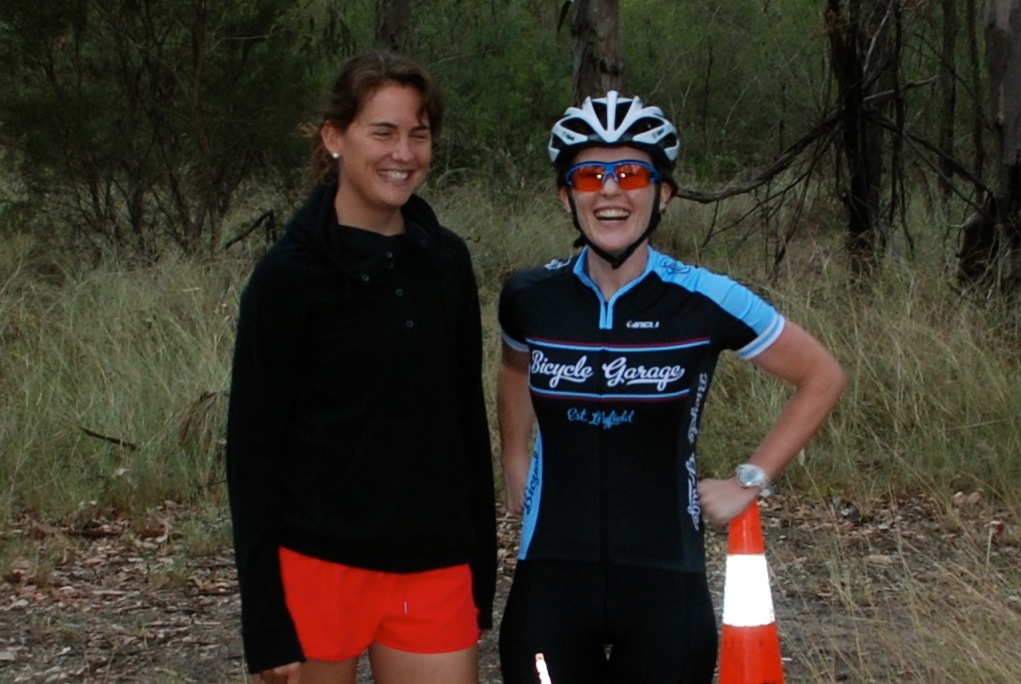
Team ‘Kath and Rosie’. We thought real hard about that one!
Watching Rosie ride reminded me how to ride. She’s so smooth through the twisty and the rough stuff. More than that, the way she was grinning through the first couple of laps made me want to go out and do the same. So we swapped turns a few more times until the clock ticked past midday. There were no other female pairs racing that day so we had the win wrapped up from the gun.
In addition to catching up with heaps of people off the bike, it was great fun smashing out some quick laps on the bike. Rosie got the fastest female lap of the day and I learned how to ride again by the end of the race pulling out a quick one right at the end. The 4 Hour format was super fun, and I really enjoyed how the racing finished on a high and without the addition of any extra scabs.
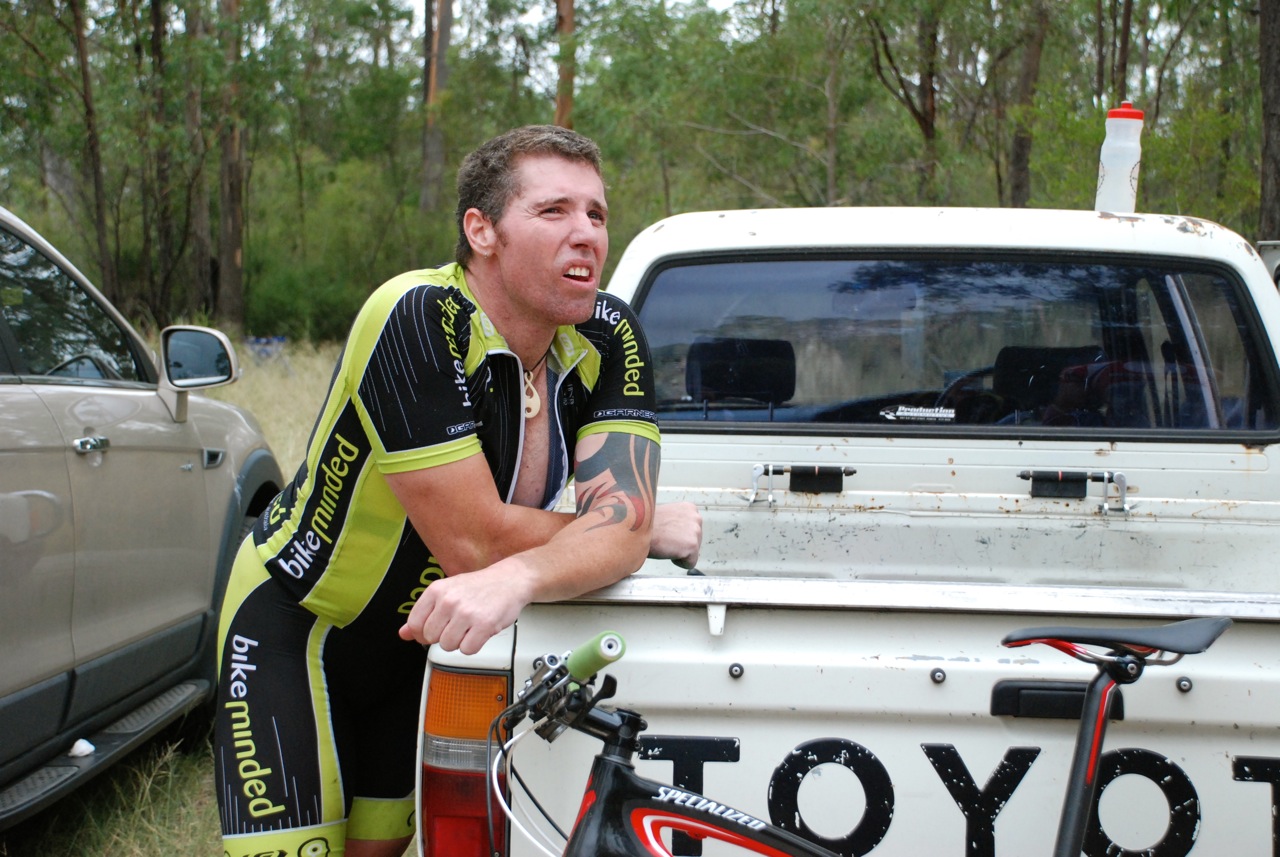
Jasen Raymond contemplates the sheer speed of his new bike (and what he’s been missing out on with the old one).
Thank you to Western Sydney Mountain Bike Club for another excellently run event. Thanks also the Bicycle Garage crew of Marty, Jez and Rae-Anne for sharing their track side set up and making the day even better still. And thanks to the trails for reminding me how to ride and that you should never be too busy to look after your bike.
Photos: Kath Bicknell (most) Big Dog (Bicky Barnesy Dream Team).
Past proceedings from the Australian Cycling Conference suggest that, at least locally, much of the research discussed there examines issues relating to uptake, infrastructure, sustainability, commuting, tourism and risk factors. When I sat down to write a paper proposal for the 2013 conference, there were two things I wanted to contribute from my own work. One was ideas about how we can look toward the actual experience of cycling to discover more about the sport and the theory often used to discuss it. Given there is so much writing on the web from cyclists, about the diverse experiences had through the sport, the second thing I wanted to discuss was how we might be able to consider writing such as this as part of a broader academic method. The full abstract for the paper is below.
The conference takes place in Adelaide, during the Tour Down Under, from 21-22 January. If you’re interested in finding out more about the topics to be covered there, have a look at the program on the website. Research from the conference will be published after the event.
Everybody’s Writing
Kath Bicknell
As participation in cycling grows, so does the amount of research on the sport. But this writing often falls short of accurately conveying the experience of cycling – what it feels like to pedal along on two wheels, and how these experiences are understood through a complex interaction of sophisticated sensory pathways.
One place that is rife with detailed accounts of riding is the blogosphere. Online communities of mountain bikers (as an example of one particular cycling culture) provide countless, reflective, first person reports of riding. These reveal the myriad experiences had while racing, travelling and preparing for the next event. Although heavily coded with insider terminology, these accounts provide rich descriptions of what anthropologist, Michael Jackson, would call the rider’s ‘lifeworld’.
This paper discusses some of the opportunities these data provide for theoretical arguments about sport and performance. By considering the experience of riding in all its lived complexity, we can then build upon ideas about embodied action and awareness to reflect upon a wide range of other circumstances, projects and events.
The 2012 Cultural Studies Association of Australasia (CSAA) conference kicks off next week. The theme for this one is Materialities: Economies, Empiricism and Things. They like big conceptual words in cultural studies, the nuances of which are always sure to open up some insightful research and conversation about things we often overlook in day-to-day life – like what it is to be a person in the (pumping, shifting, ever-changing) world, or how groups of people make sense of moments, events and trends in particular times and places.
This conference appears to be one of the best organised that I have attended, too. It even has it’s own app. Monday kicks off with a postgrad/early career researcher event. Along with sessions on grant and journal writing, topics like academic use of social media will be interesting to hear about as well. The conference proper runs from Tuesday to Thursday.
It’s a great feeling when you look through a conference program in advance and get excited about several different panels at once. It means your own research is crossing a number of conceptual boundaries and that there are countless opportunities to develop this thinking in relation to the thoughts and findings of others.
I’ll be talking about endurance mountain bike riding as a way into a broader discussion on the perception and management of fatigue.
Body-As-Object and the Materiality of Fatigue
“I’ve had some hard races and pushed myself before; I’ve been dizzy and had tunnel vision, I’ve gone deep enough that I could taste metal in my mouth from protein break down… but none of those experiences even comes close to this race. There is a line somewhere in the sand, and this time I crossed it and went too far.” [1]
24 Hour Solo is a rapidly growing discipline within the sport of mountain bike racing where participants ride from midday one day until midday the next. For some athletes it’s the difficulty of the competition that attracts them to the challenge. For others, they are curious to find out how far they can push their bodies: what new knowledge will they discover about its motivation and materiality that they can’t find out in their regular day-to-day?
Science provides clear insights into the reasons for experiences like McAvoy’s above and explains why some racers finish looking fresh, while others may fail to finish at all. What interests me is that hundreds of people line up at the start line to experience it for themselves. A process that, regardless of any objective knowledge of what may happen, must be phenomenologically policed.
It is easy to shake our heads at this type of competition and label it as irrational or odd. But this behaviour is nothing new; human kind has long sought out ways to test the limits of their material selves. This paper asks what we might learn from people’s reports. I will explore some of the strategies riders use to monitor and overcome these situations and discuss new ways of looking at theories of embodied cognition and action that come up as a result.




 Kath Bicknell