

Macquarie University in Sydney hosted the 2013 conference for the Australasian Skill Acquisition Research Group – ASARG. This yearly event pulls together thinkers from a variety of disciplines with an interest in skilled performance, particularly in sport.Continue reading “Australasian Skill Acquisition Research Group Conference”
Category Archives: Research
Prize for Best Academic Paper at the Australian Cycling Conference

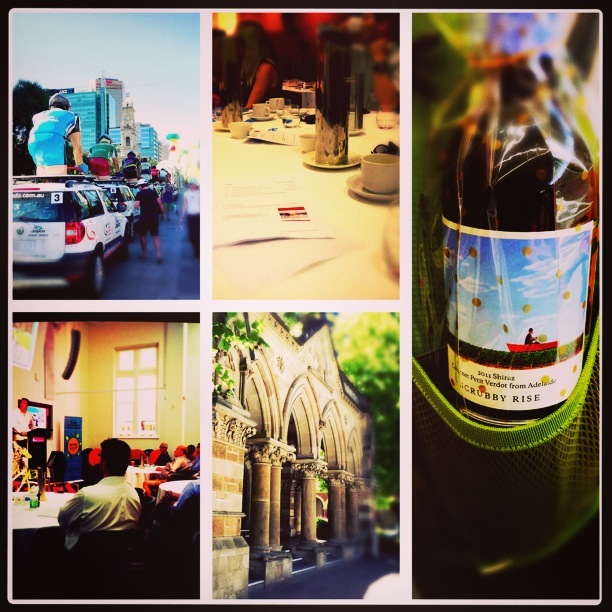
When it was announced that I’d won the prize for Best Academic Paper at the 2013 Australian Cycling Conference I probably would have fallen off my chair had I been able to move. The prize was for the written version of the paper, submitted before the conference began, and recognises not just the quality of my work, but the relevance it holds to the work of others.
Most of the people presenting at this conference are involved in projects that make the sport of cycling more accessible to the wider Australian community or are looking at data indicating ways in which that community can grow. There were a lot of graphs.
As I sat there listening to people talk about these projects over the two-day event, I kept thinking how lucky I was to be sitting in a room full of people who make the world I live in a better place. But not just for cyclists, for other people too – whether it’s building a bike path that encourages people to get outside and walk as well, or working strategically to develop safer commuting routes which reduce traffic congestion and improve the landscape of certain areas along the way. Projects that encourage more people to get involved in the sport have the potential to really change people’s confidence, sense of self, physical health and mobility, and the ease of their day-to-day.
I take riding and bike facilities for granted sometimes, but sitting in this room made me so grateful for the work people do to make them a reality. It’s certainly motivating to know that the work I do can have an impact in these areas as well, but for me the real impact is the lessons I learned at this conference from others.
There were two other prizes awarded; one for best student paper and one for a practitioner. Both other recipients are a similar age to me indicating that there’s a whole lot of exciting work to come from people who are at the beginning of this journey too.
Next year’s conference will merge into the international Velo-City conference in May. If you work in any area of cycling I encourage you to come along and see how far reaching this sport really is.
Photo: Kath Bicknell
Australian Cycling Conference – Everybody’s Cycling?
Past proceedings from the Australian Cycling Conference suggest that, at least locally, much of the research discussed there examines issues relating to uptake, infrastructure, sustainability, commuting, tourism and risk factors. When I sat down to write a paper proposal for the 2013 conference, there were two things I wanted to contribute from my own work. One was ideas about how we can look toward the actual experience of cycling to discover more about the sport and the theory often used to discuss it. Given there is so much writing on the web from cyclists, about the diverse experiences had through the sport, the second thing I wanted to discuss was how we might be able to consider writing such as this as part of a broader academic method. The full abstract for the paper is below.
The conference takes place in Adelaide, during the Tour Down Under, from 21-22 January. If you’re interested in finding out more about the topics to be covered there, have a look at the program on the website. Research from the conference will be published after the event.
Everybody’s Writing
Kath Bicknell
As participation in cycling grows, so does the amount of research on the sport. But this writing often falls short of accurately conveying the experience of cycling – what it feels like to pedal along on two wheels, and how these experiences are understood through a complex interaction of sophisticated sensory pathways.
One place that is rife with detailed accounts of riding is the blogosphere. Online communities of mountain bikers (as an example of one particular cycling culture) provide countless, reflective, first person reports of riding. These reveal the myriad experiences had while racing, travelling and preparing for the next event. Although heavily coded with insider terminology, these accounts provide rich descriptions of what anthropologist, Michael Jackson, would call the rider’s ‘lifeworld’.
This paper discusses some of the opportunities these data provide for theoretical arguments about sport and performance. By considering the experience of riding in all its lived complexity, we can then build upon ideas about embodied action and awareness to reflect upon a wide range of other circumstances, projects and events.
2012 Cultural Studies Association of Australasia Conference
The 2012 Cultural Studies Association of Australasia (CSAA) conference kicks off next week. The theme for this one is Materialities: Economies, Empiricism and Things. They like big conceptual words in cultural studies, the nuances of which are always sure to open up some insightful research and conversation about things we often overlook in day-to-day life – like what it is to be a person in the (pumping, shifting, ever-changing) world, or how groups of people make sense of moments, events and trends in particular times and places.
This conference appears to be one of the best organised that I have attended, too. It even has it’s own app. Monday kicks off with a postgrad/early career researcher event. Along with sessions on grant and journal writing, topics like academic use of social media will be interesting to hear about as well. The conference proper runs from Tuesday to Thursday.
It’s a great feeling when you look through a conference program in advance and get excited about several different panels at once. It means your own research is crossing a number of conceptual boundaries and that there are countless opportunities to develop this thinking in relation to the thoughts and findings of others.
I’ll be talking about endurance mountain bike riding as a way into a broader discussion on the perception and management of fatigue.
Body-As-Object and the Materiality of Fatigue
“I’ve had some hard races and pushed myself before; I’ve been dizzy and had tunnel vision, I’ve gone deep enough that I could taste metal in my mouth from protein break down… but none of those experiences even comes close to this race. There is a line somewhere in the sand, and this time I crossed it and went too far.” [1]
24 Hour Solo is a rapidly growing discipline within the sport of mountain bike racing where participants ride from midday one day until midday the next. For some athletes it’s the difficulty of the competition that attracts them to the challenge. For others, they are curious to find out how far they can push their bodies: what new knowledge will they discover about its motivation and materiality that they can’t find out in their regular day-to-day?
Science provides clear insights into the reasons for experiences like McAvoy’s above and explains why some racers finish looking fresh, while others may fail to finish at all. What interests me is that hundreds of people line up at the start line to experience it for themselves. A process that, regardless of any objective knowledge of what may happen, must be phenomenologically policed.
It is easy to shake our heads at this type of competition and label it as irrational or odd. But this behaviour is nothing new; human kind has long sought out ways to test the limits of their material selves. This paper asks what we might learn from people’s reports. I will explore some of the strategies riders use to monitor and overcome these situations and discuss new ways of looking at theories of embodied cognition and action that come up as a result.
[1] McAvoy, Jason. 2011. “2011 Scott 24 Hour Race.” Wicked Rides. 13 October. http://wickedrides.com.au/24-2011/scott/
Saumur, 15 Years Later

Most of the recent stories on this website describe ways of getting to know a country, or countries, by bike. In 1998 I discovered France as a high school student. Saumur, a 30,000 person town in the Maine-et-Loire – an area known for beautiful wines, many old chateaus and small houses built into rockfaces – was my temporary home.

 Kath Bicknell